
Single-Source GTM Campaign
Midwest Alarm Services | Regional Full-Service Life Safety Integrator
End-user Demand Generation | Fractional Engagement, 2024 to Present
What this is:
-
Client: Midwest Alarm Services, a regional full-service life safety integrator operating across 15 branches in the Midwest
-
Engagement: Fractional Marketing Director, 2024 to present
-
Campaign goal: Position Midwest Alarm as a single-source partner for fire, security, and life safety, moving the brand from vendor to consultant in the eyes of facility managers, building owners, and construction professionals
What I built:
-
A LinkedIn ad campaign targeting new prospects across Missouri and Michigan, using sponsored content and message ads across two audience segments
-
A three-part automated email nurture sequence for existing customers, driving toward a vendor consolidation assessment and personalized follow-up
-
HubSpot automation connecting lead capture, routing, and dynamic email generation
-
Supporting website updates and sales enablement assets
The Challenge
Facility managers and building owners often manage separate vendor relationships for fire protection, security, inspections, and emergency communications. That fragmentation creates administrative burden, increases operational risk, and makes code compliance harder to track. The opportunity for Midwest Alarm Services was clear: position the company as the single partner capable of handling all of it, and make that case to the right decision-makers before a competitor does.
Midwest Alarm had never run a structured LinkedIn advertising campaign or an automated email nurture program for existing customers. Both represented untapped channels with real potential for qualified lead generation and revenue expansion.
The Strategy
I developed a go-to-market campaign built around a single-source positioning strategy, running two parallel and independent programs simultaneously. One targeted new prospects through LinkedIn. The other targeted existing customers through an automated email nurture sequence.
Rather than leading with product features, both programs lead with the prospect's pain: the cost, risk, and operational friction of managing fragmented vendors. They position Midwest Alarm as the partner that eliminates it. The goal at every stage is to move the conversation from a commodity price discussion to a consultative engagement focused on risk mitigation and operational efficiency.
LinkedIn Ad Campaign
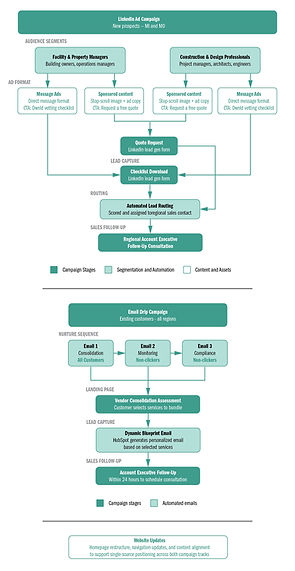
Midwest Alarm's first structured LinkedIn advertising effort. The campaign targeted two audience segments, facility and property managers and construction and design professionals, across two regions (Missouri and Michigan) using two ad formats running simultaneously.
Sponsored content ads used a stop-scroll image and copy format with a CTA to request a free quote. Message ads used a direct one-to-one format with a CTA to download a vendor vetting checklist, a technical asset I developed to help prospects evaluate low-voltage partners against a defined set of criteria covering system expertise, integration capability, compliance credentials, and long-term service capacity.
All leads captured through LinkedIn lead generation forms were automatically routed to the appropriate regional account executive for follow-up.
Email Drip Campaign
A three-part automated nurture sequence targeting all existing Midwest Alarm customers. Each email addressed a distinct pain point: vendor consolidation, monitoring fragmentation, and inspection compliance. All three drove recipients to a vendor consolidation assessment landing page.
The assessment asked customers to identify which services they currently manage through separate vendors. On submission, a HubSpot workflow automatically generated and delivered a personalized follow-up email populated with relevant service information based on their specific selections. The account executive for that region was then notified to follow up within 24 hours to schedule a consultation.
Non-clickers from each email moved automatically to the next message in the sequence, keeping the nurture active without manual intervention.
Supporting Infrastructure
Both campaign tracks required corresponding updates to the Midwest Alarm website. I led a restructure of the homepage and navigation to align with the single-source positioning, reorganizing the service categories to more clearly communicate the full scope of the integrated offering and adding content sections that establish the company's four core service pillars.
I also developed a suite of supporting sales enablement assets including a single-source vendor vetting checklist and standardized RFP templates for the business development team.
My Role
I'm functioning as the full marketing department for Midwest Alarm Services, reporting to the CRO and the marketing director of parent company Per Mar Security Services. I designed both campaign tracks from strategy through execution: developing the positioning, writing all copy, building the HubSpot automation workflows, setting up and managing the LinkedIn campaigns, producing all supporting assets, and leading the website updates. This campaign is one component of a broader annual marketing strategy I developed and own for the client.
Status and Next Steps
This was Midwest Alarm's first LinkedIn advertising campaign. The sponsored content ads ran a defined test period in Missouri and Michigan, generating data on cost per lead, audience receptivity, and ad performance by format and region. That data is informing decisions on budget allocation, creative direction, and targeting for the next phase.
Message ads were paused before completing the full test period. The vendor vetting checklist, the primary lead magnet for that format, was still being finalized at launch. With the checklist now complete, message ads are ready to reactivate as part of the next campaign phase.
The email drip campaign targeting existing customers is active and ongoing. Final performance metrics across both tracks are not yet available for this page. It will be updated as results come in.